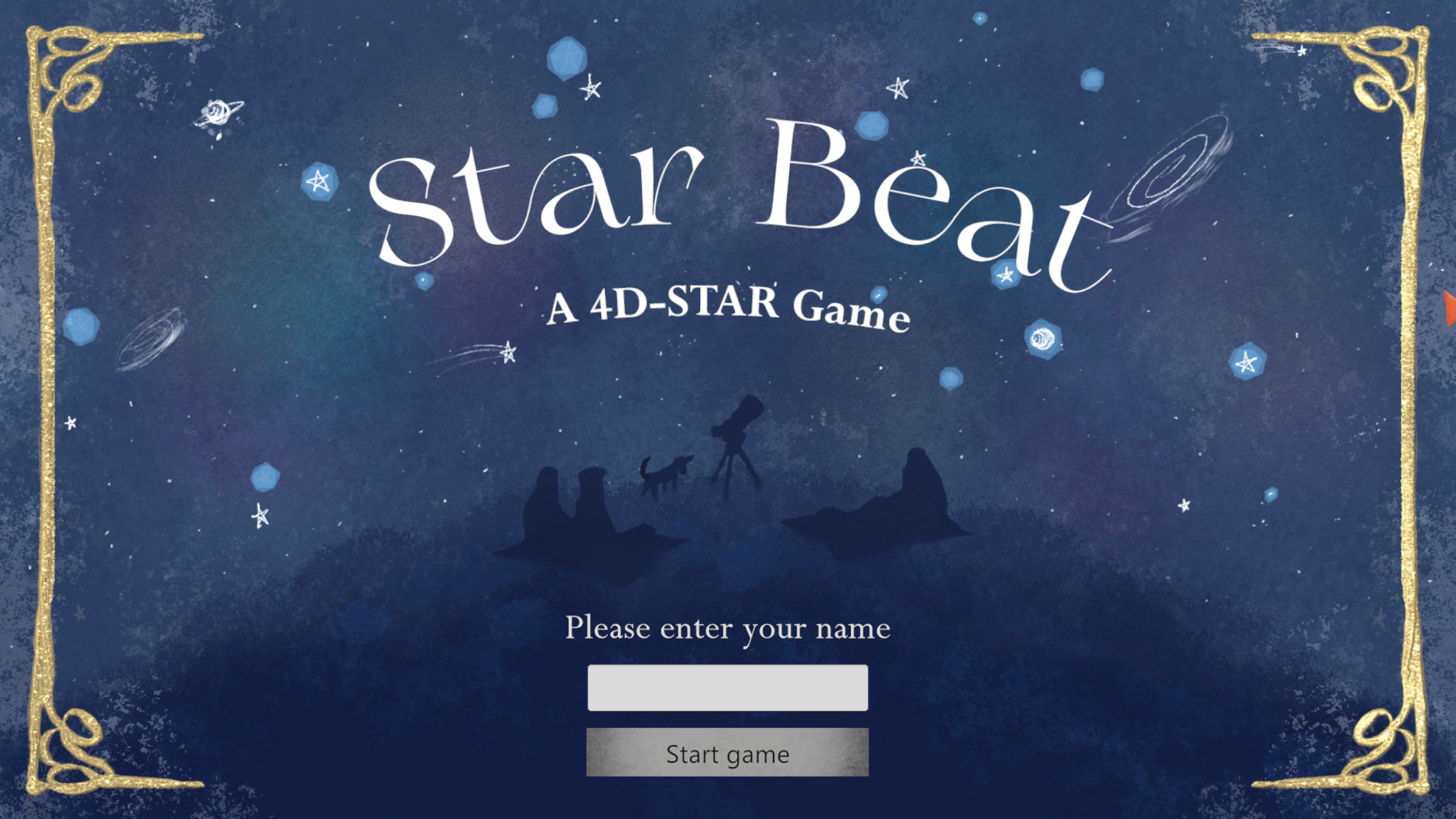
What can the vibrations of a distant star tell us about its interior? A new educational video game invites players to find out for themselves.
Star Beat is a new web-based game that allows players to step into the role of aspiring asteroseismologists and investigate real observations from NASA’s Kepler mission. Designed with students and the wider public in mind, the game offers an accessible introduction to a field of astronomy that is usually only explored at university level.
Asteroseismology is the science of listening to the vibrations of stars. Many stars constantly pulsate, like enormous musical instruments, creating waves that travel through the different layers of the star. These vibrations can be seen by astronomers as variations in the brightness of stars. Looking at these brightness variations allows scientists to peer inside, into the interior of the star that is normally hidden, to measure its age, mass, radius, and rotation.
In the game, players join an asteroseismology research group as new interns, tasked with identifying stars observed by the Kepler mission. As they explore an interactive office, learn the basics of stellar oscillations, and analyse authentic astronomical data, they gradually develop the skills needed to recognize oscillation patterns and match stars to entries in a catalogue of known pulsating stars. Along the way, they unlock new areas to explore and discover new ways to engage with the stars.
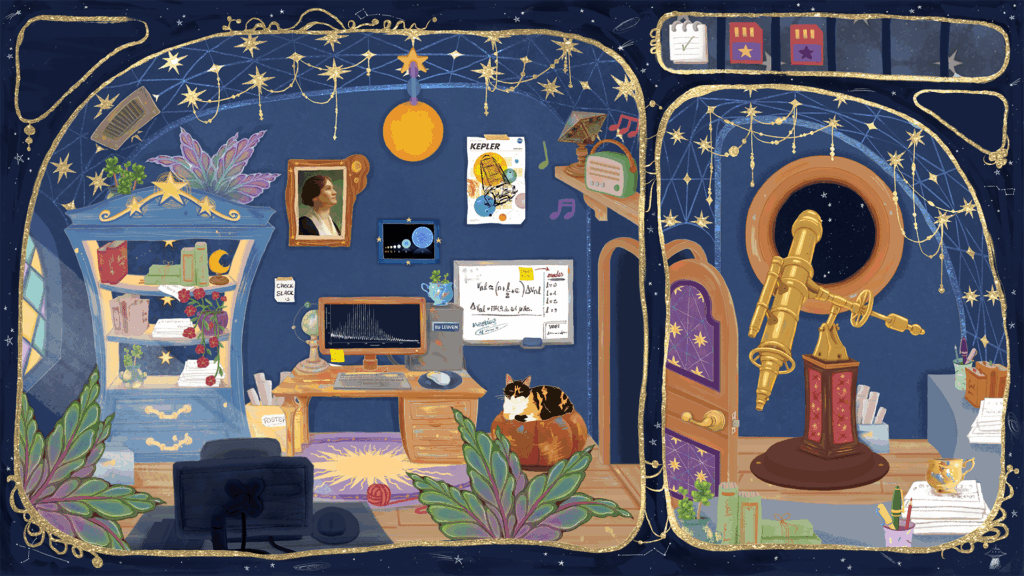
Designed and illustrated by Ana Núñez, a video game design student at Howest Digital Arts & Entertainment, and developed by Pablo Huijse, postdoctoral researcher at the Institute of Astronomy of KU Leuven, Star Beat combines authentic science with hand-drawn artwork and a relaxed, curiosity-driven approach to learning.
“Science can often seem complex and intimidating,” says Ana Núñez. “My intention was to spark curiosity and a sense of wonder for the beauty of our Galaxy, making astronomy accessible to everyone. As a game designer, I focused on turning scientific concepts into engaging gameplay, creating an experience where players could explore, learn at their own pace, and discover the stars without the pressure of failure.”
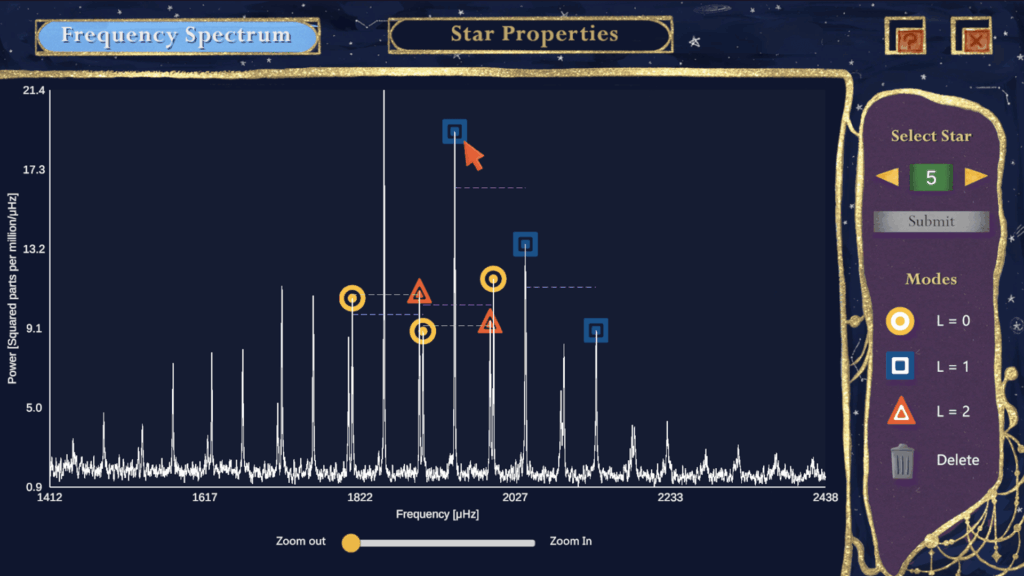
“Asteroseismology allows us to study the interiors of stars through their oscillations, much like seismologists study the Earth’s interior using earthquakes,” says Pablo Huijse. “We wanted to give players the opportunity to experience a simplified version of that scientific process and discover that real astronomy can be both accessible and fun.”
The creators hope that Star Beat will help students, teachers, and the wider public develop a deeper appreciation of astronomy and discover how researchers use stellar vibrations to uncover the secrets of distant stars.
Play the Game
Whether you are a student, educator, astronomy enthusiast, or simply curious about the Universe, we invite you to explore the hidden patterns of stars and discover the fascinating work of asteroseismologists.
Ready to identify your first star?
Star Beat is free to play on itch.io: https://bruja-aprendiza.itch.io/star-beat
For the best experience, we recommend playing on a PC or tablet.
For more information about the game and its development, visit Ana Núñez’s portfolio
The research and development leading to this game results has received funding from the European Research Council (ERC) under the Horizon Europe programme (Synergy Grant agreement N◦101071505: 4D-STAR). While partially funded by the European Union, views and opinions expressed are however those of the author only and do not necessarily reflect those of the European Union or the European Research Council. Neither the European Union nor the granting authority can be held responsible for them.