In their editorial, João Alves and Thierry Forveille highlight Astronomy & Astrophysics’ motivation to start with a new type of article in the journal’s portfolio. Astronomy & Astrophysics is a leading, peer-reviewed scientific journal that publishes research articles across all fields of astronomy and astrophysics.
Invited authors Conny Aerts & Andrew Tkachenko of the KU Leuven Institute of Astronomy concur:
“It is a true honour for us to have been given the opportunity to write Astronomy & Astrophysics’ first Review Article. Rather than producing yet another general review on asteroseismology, we wanted to summarise its applications to fast rotators, because this was so far not yet the focus of a dedicated review, while progress in the derivation of their internal physics is impressive. Fast rotating stars are not spherical but rather oblate, and so they challenge the current standard of 1-dimensional stellar models”.
For the last two decades, asteroseismology from space photometry has been revolutionising stellar astrophysics and, by implication, all fields that rely on stellar evolution models. Asteroseismology exploits the frequencies of nonradial oscillation modes and provides a unique and detailed picture of stellar interiors. This technique delivers key insights into the deep layers of stars, all the way up to their cores, in terms of rotation, magnetic fields, mixing of the stellar material and consequences of tides.
Guiding future theory of stellar structure and evolution
The Review Article is highly praised by Michel Rieutord, University of Toulouse: “This Review Article provides a comprehensive overview of observational facts on the seismic properties of rotating stars.” Along with Conny Aerts, Michel Rieutord is one of four principal investigators on the ERC Synergy Grant 4D-STAR, a joint 6-year project hosted by KU Leuven, University of Toulouse, CEA/Saclay, and Dartmouth College with the aim to develop 3-dimensional models predicting how fast rotating stars evolve throughout their life. Michel Rieutord continues:
“These facts [presented in the Review Article] need to be matched by the novel 3-dimensional models that our Synergy Grant aims to provide to the scientific community. The Review Article by Aerts & Tkachenko is therefore very timely and most welcome to guide theorists and software developers in their construction of new better models that properly take into account the deformation of a star caused by its rotation.”
This position is further emphasised by 4D-STAR software developer Emily Boudreaux at Dartmouth College:
“Stellar structure and evolution models are the most essential tool the astrophysics community has for doing controlled science. They have allowed us to probe questions as disparate as what is the age of the universe all the way to what is the efficiency of chemical mixing in hot plasma. It is time to upgrade the models because we have been pretending for too long that stars are spheres. The effectiveness of our new 3-dimensional models under construction requires precise calibrations of the underlying physics, and asteroseismology is a champion in delivering that.”
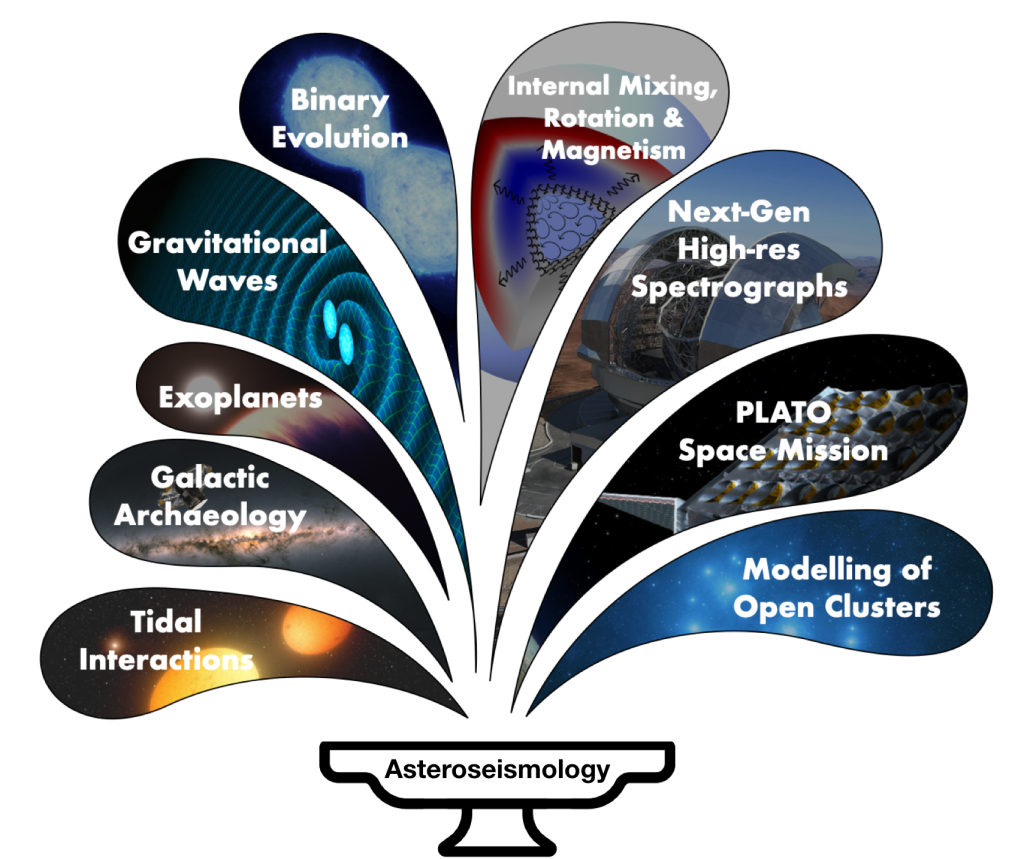
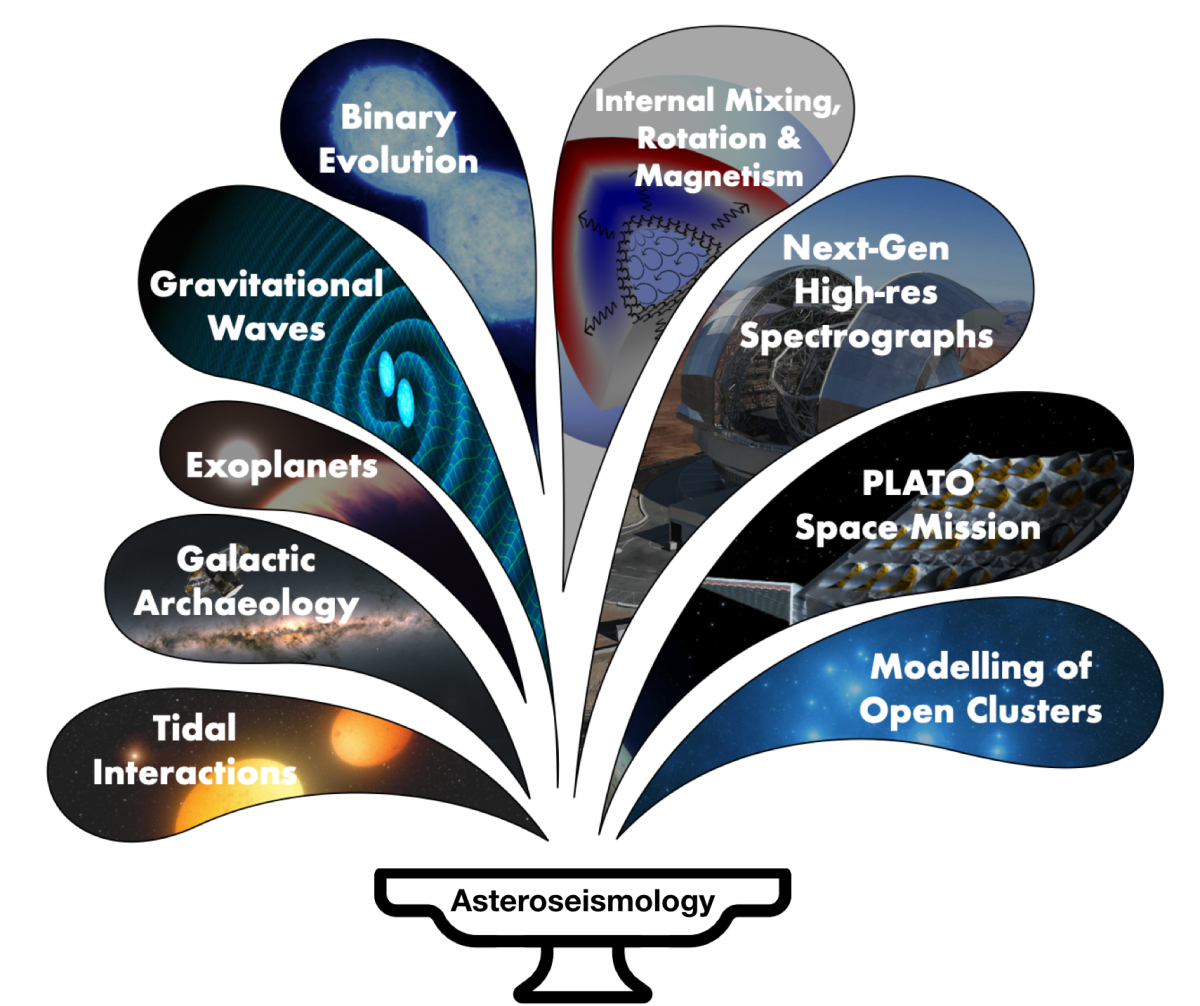
Asteroseismology provides a fountain of opportunities for astrophysics. (Design: Conny Aerts, Implementation: Clio Gielen. Credit of the thumbnail images, from bottom left to bottom right: 1. NASA/JPL-Caltech – 2. ESA/ATG medialab-ESA/Gaia/DPAC;-A. Moitinho – 3. NASA, ESA, CSA, Joseph Olmsted (STScI) – 4. R. Hurt/Caltech-JPL – 5. ESO/L. Calçada – 6. Pieter Degroote (priv. comm.) – 7. ESO – 8. ESA – 9. Davide De Martin & the ESA/ESO/NASA Photoshop FITS Liberator.)
A fountain of opportunities for future astrophysics
As shown in the figure (above right), asteroseismology offers wide-ranging opportunities, from enhancing galactic archaeology and facilitating star-planet interactions to understanding the lifecycle of massive stars that culminate in supernovae and form black holes. It explores how gravito-inertial waves – slow oscillations in fast-rotating stars – offer a unprecedented and detailed view of stellar interiors, shaping future studies on stellar evolution under extreme conditions and in close binaries. These insights link stellar astrophysics to gravitational wave research, bridging the fields of asteroseismology and multi-messenger astronomy.
“The Review Article emphasises the major potential of asteroseismology from the (expected) influx of high-precision data from the ongoing Gaia and TESS and upcoming PLATO missions. It sets the stage for more descriptive theory and more accurate stellar models that will help answer some of the most fundamental questions about the Universe.”
conclude Ashlin Varghese and Joey Mombarg, postdocs at the CEA/Saclay node of 4D-STAR.
The full Review Article text is available here: https://www.aanda.org/10.1051/0004-6361/202348575